Just twenty-six events over this two-month period. 16 of those were online with Chainsaw Poker, whose members (not me!) had an impressive showing at this summer’s World Series of Poker in mixed events. One of the admins calculated that every $1,500 buy-in mixed event had at least one member of the club, and there was one final table where every person was a member.
Sadly, my performance in the club this past couple of months fell off from the previous months, with a couple of bubbles, a Stud/8 where I got crushed on the river after being dealt rolled-up trip 7s and I ended up going out 12/17 when I should have been a chip leader going into the second half of the tournament. Down about nine buy-ins here.
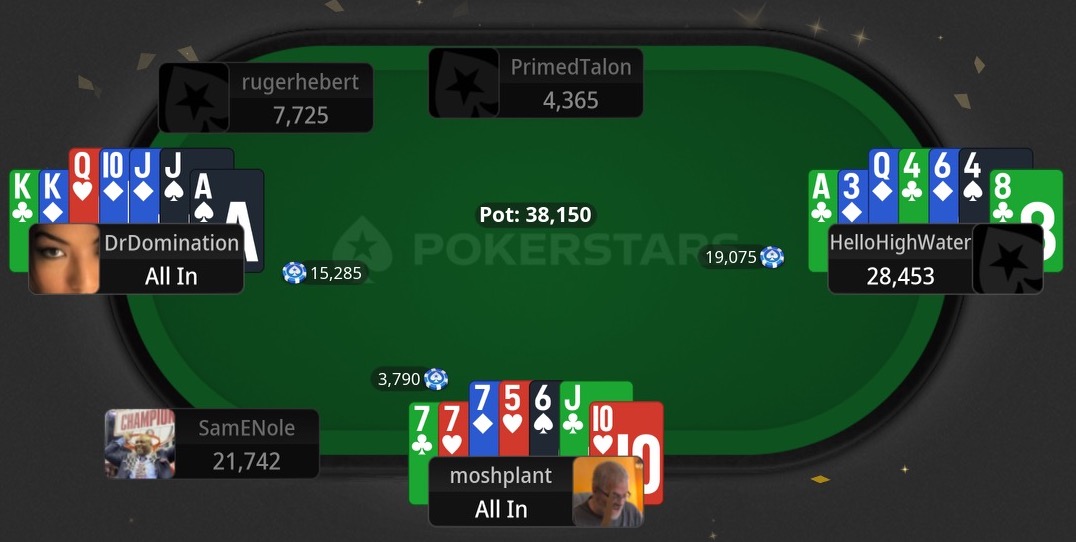
Capped on every street
The home game in June had more players than it has for quite a while—back in the oughts we sometimes went to three tables—but I bubbled this one as well in 4th place.
My two shots at Portland Meadows: a 5-Card PLO Lockout and a 5-Card PLO Bounty were busts. Didn’t make it much past the break in the bounty (and this time I didn’t get a bounty to salve my feelings), and while I made it to the final third of the players in the Lockout. What’s a Lockout you might ask? This is how Meadows describes it:
What is a lockout tournament? In this 5 card pot limit omaha tournament there are no blinds, instead the button posts an ante every hand and action starts to the left of the button. Players may call the ante or fold preflop. Once the action gets back to the button, they can check or raise; raising re-opens the action for everyone!!!
Had the 2nd nuts in the bounty tournament that knocked me out early and I went for a rare rebuy, but that still had me out 30 minutes after I got there. 3 buyins down for Meadows.
The Beaverton Quarantine game was a bust, too. Just one cash out of seven tournaments and that was in one of the smaller NLHE bounty games. So down four buyins, but at least they’re small.
Missed out entirely on this summer’s action in Las Vegas, and I wasn’t able to get away from town even for the Chinook Winds Summer Poker Classic.
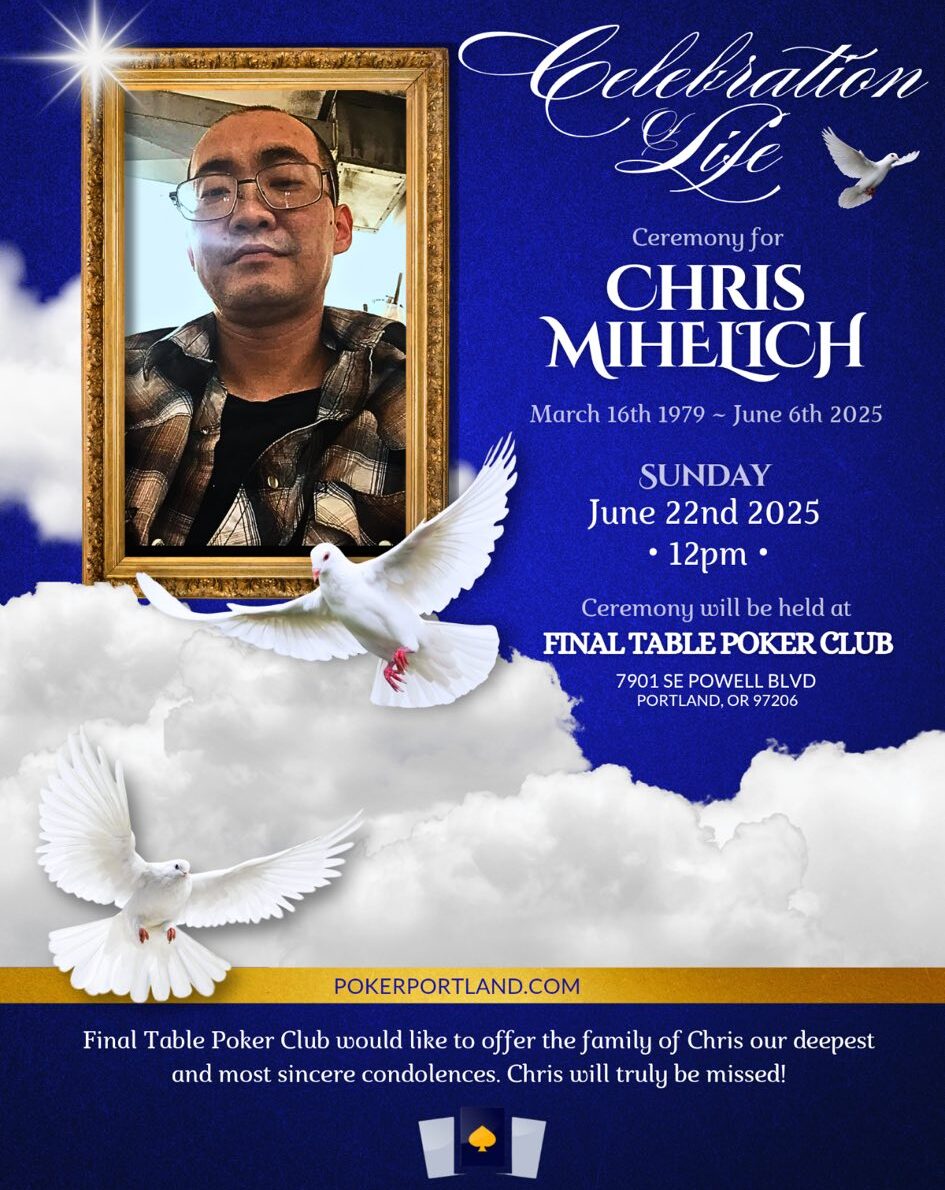
I can’t close this out without mentioning that I did go out to Final Table Poker Club for their June First Friday $20K GTD NLHE tournament, but found out at the door it had been cancelled because one of the dealers had a medical emergency in the afternoon and later passed away. Most players in the Portland-area community know how hard the volunteer dealers here work, and how much the clubs and the whole poker ecosystem here depends on them, so it was nice to see how everyone came together when something like this happens.
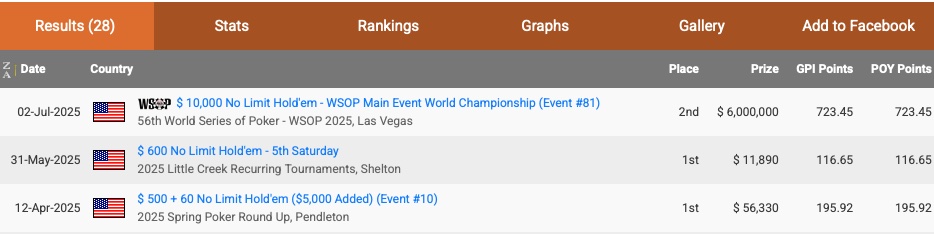
Coming up in August? Who knows? None of my poker plans the past few months have panned out, but starting the 20th there is the Wildhorse Summer Poker Round-Up (the winner of spring’s Main Event did just make 2nd place at the WSOP Main Event), and at the end of August, it’s the Wild West Poker Tour atPortland Meadows, with the Chinook Winds Fall Poker Classic [Facebook group link] right on its heels in early September. Crossing my fingers!
It’s been a busy couple months here at Mutant Poker, even though my playing volume is still so much lower than it used to be and I don’t have any plans to go to Las Vegas this summer because of real-life stuff. Things to be happy about, though!
The Poker
First off, the past couple of months have beenprofitable, if not enormously so, which is always an accomplishment for someone who plays tournaments almost exclusively. I played just 25 tournaments (5 in April and 20 in May), with only two of those live (more on these types of numbers later).
No live poker at all in April, just a couple of small online home games and three in an online poker league. I bricked the first three (two Stud/8 tournaments and a NLHE Bounty), then won a single-table PLO tournament and a 21-entry 8-Game Mix that saved the month.
Just 6 of the 20 tournaments in May were NLHE (one live). I took first in two of the online home games. I was on a roll from the start in the live home game—nearly knocking out two players on the second hand—right up to the bubble when a player who’d clawed his way up from nothing at first lost a flip against me on the flop then hit a set on the turn and left me gasping for air and the booby-prize of less than half a buy-in.
The rest of the games were PLO/8 and PLO/8 Bounty (5), PLO (1), 8-Game Mix (3), HORSE (1), Stud/8 (3), and O/8 (1). I cashed in half of them and won the PLO, a PLO/8 Bounty, an 8-Game, and a Stud/8. The buy-in’s aren’t huge, the fields aren’t particularly big, but it’s great to be able to play something other than NLHE so regularly.
This would all theoretically hearken well for a WSOP trip, but no.
The Stats
May marks 14 years since I started keeping track of every real-money poker event (cash and tournaments). I built my own primitive online tracking tool just after Black Friday and a shift to live poker put a kibosh on automatically recording everything with Poker Tracker. At the time, I also had some ideas on how gauge the future profitability of tournament poker players who can be good even if they’re underwater financially.
Here are some stats on the local rooms I’ve played in in that time:
1 event at Big Stack Poker Club (does that put me at 100 with Brian Sarchi?)
1 event at Trio Poker Room
The bulk of that was in the years between 2011 and 2016, which is one of the reasons the Meadows number is so low, relatively. I went to work at the WSOP in the summer of 2016 after being mostly unemployed for years (hint: not the best time to pick up poker as a hobby unless you’re good at it) and came back to a job offer that took me off the streets during the weekdays when I had been frequenting Final Table, PPC, and Encore.
When I posted this in the NW Poker group on Facebook the other day, I got queries about some of the other fine rooms that have existed in the past 15 years. There are places I just didn’t get to. Sorry.
The Tracker
One of my projects the past month has been to update the software I use to track my poker playing. I wrote a crude system back in the spring of 2011 using mySQL (online database software) and PHP (a scripting language) but I’m a hack programmer. While I’ve been working with and programming computers since the days when we used paper tapes and punch cards, my formal programming training ended before any of the modern languages were even developed and more than a decade before the birth of the World Wide Web. Event the languages I did learn in depth (and wrote books and articles about) are long-dead. It’s been more than 20 years since I wrote my last book. So what I created was pretty unsophisticated but it did most of what I wanted it to do, which was to sort events by start and end dates, cash and/or tournaments, venues, minimum and maximum entrants for tournaments, and min/max buy-ins. Plus, it showed running totals for cost, payouts, and profits over the selected time period, median ROI for profitable tournaments, and the value of a metric I came up with called Tournament Performance Index, which is derived from a ratio of percentage of tournament cashed and the median ROI.
The “design” of the old tracker was pretty minimal, but it did use different backgrounds on tournaments and cash games, with varying shades for profitable events and unprofitable events. Despite the fact that part of my actual job is implementing the design for web sites, I didn’t put a whole lot of time into making it look nice, because I was the only person who was going to see it; I never had any intention to make it into a product—I’m not that kind of guy (i.e. a good businessman).
I’ve been wanting to do a revamp for a long time, and there were some features I wanted that were just too much of a hassle to add for just myself, but a recent evaluation of Codeium’s Windsurf Pro AI coding aid led me to do a complete rewrite of the PHP backend (API or Application Programming Interface that communicates to the database) and front-end. The front end was originally written in PHP, returning an HTML web page to the browser. My goal was to do something more modern, with a front end written in React, a JavaScript variant that does its work in the viewer’s browser. I’ve done a fair amount of work in React over the past five or six years, but most of it has been making data look pretty, not on actually fetching and slicing and dicing the data. If I was doing that for work, it’d be one thing, but any time I spend on tracker development is time I could be playing poker.
Windsurf certainly didn’t do the job instantly. Nor did it execute instructions with perfection. I found that with some tasks, once a component had been built, it was at times far more difficult to refine the component to get it to do what I wanted than it was to throw it all away and start over, knowing where I’d run into problems on the prior attempt. But with a couple of days of work, the basics of the tracker had been completely rebuilt. With a few more days poking at it, it was on a par with the pool I’d built up in dribs and drabs over 14 years, and even had a few new twists. Plus, it was going to be far easier to add new features.
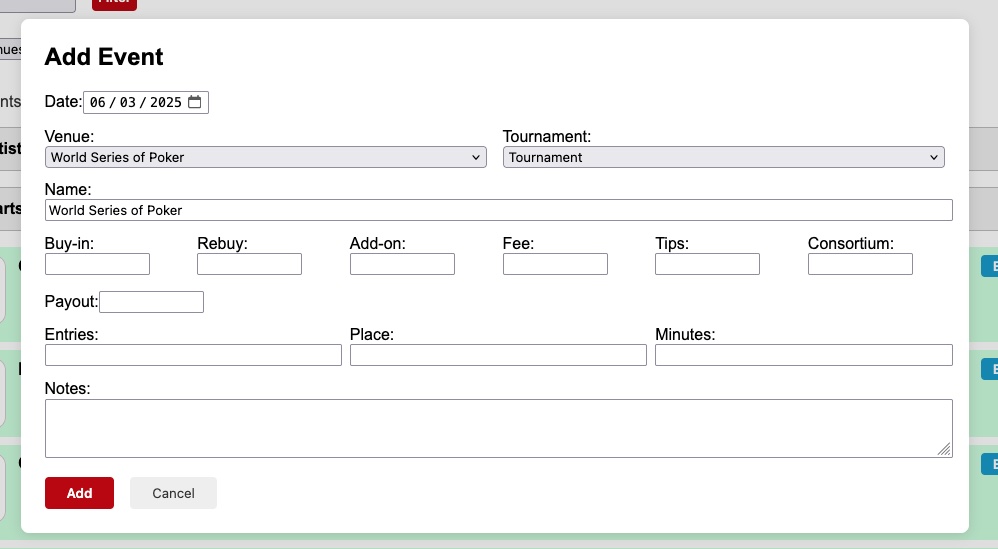
At the heart is a simple form where all of the content should be obvious except for consortium which was a long-ago plan for a few of the guys in our home game to share a portion of our winnings, which—apart from me paying out $300 for the first $10K GTD I final tabled at Encore Club back in 2011—never saw any other money transacted. I could probably get rid of that column but it’s in the database.
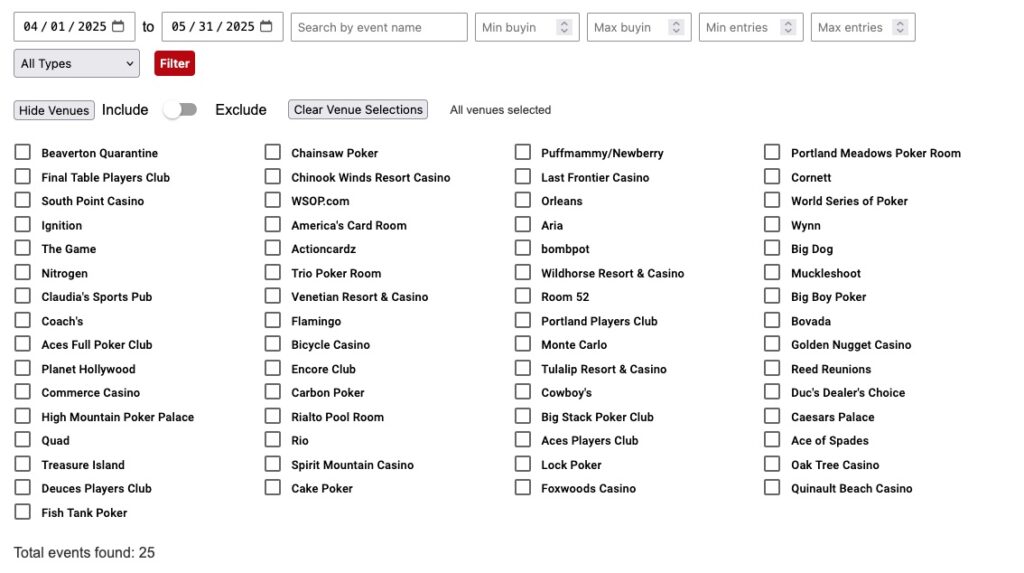
I can filter events by date, name, buy-in,, and number of entries, and can show or hide by venue. I’ve been taking photos of tournament screen when I bust out for almost 15 years now, so it’s pretty easy to keep track of that info even if I don’t feel like entering it in right away. Believe it or not, I’m more likely to forget to take a photo when I’ve cashed than when I’ve busted short of the money.
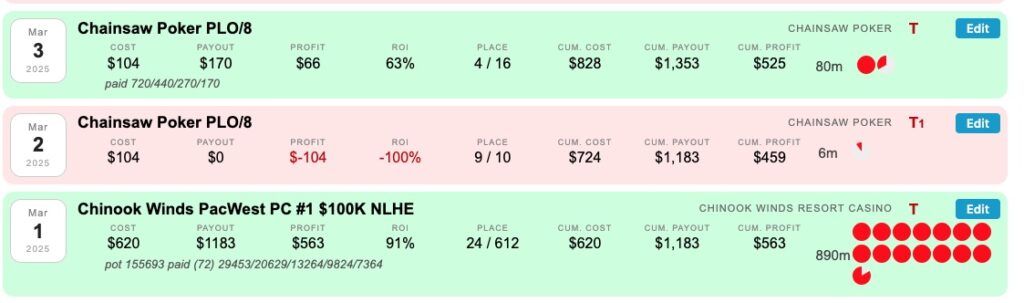
Individual events have their own row with the date, event name venue, event type (T here for three tournaments). A number after a T indicates the number of tournaments in a row without a profit (thankfully just 1 here). An identifier for the venue. Basic financials, placement, cumulative financials, notes under the number on rebuys, addons, and payouts (if I take them). And a little graphic indicator to indicate the number of minutes played in the event (one full circle for each hour).
Yes, I only lasted 5 minutes in the game in the middle. It was a max late reg!
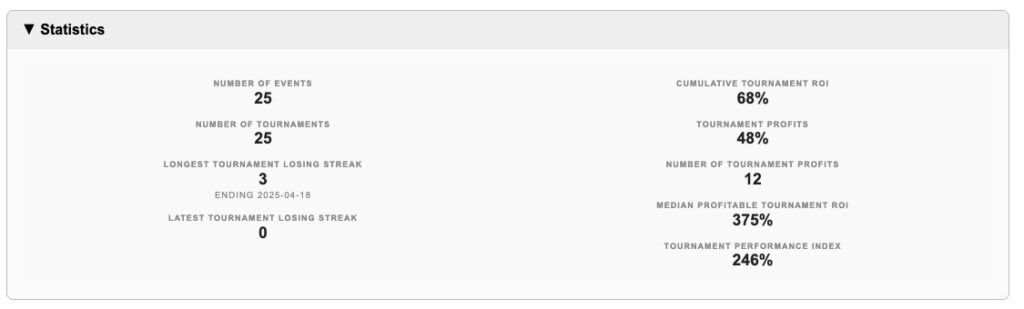
Up near the top are some tournament stats. As I said earlier, I’ve been running hot the past couple months, at least in my very minor-league circles.
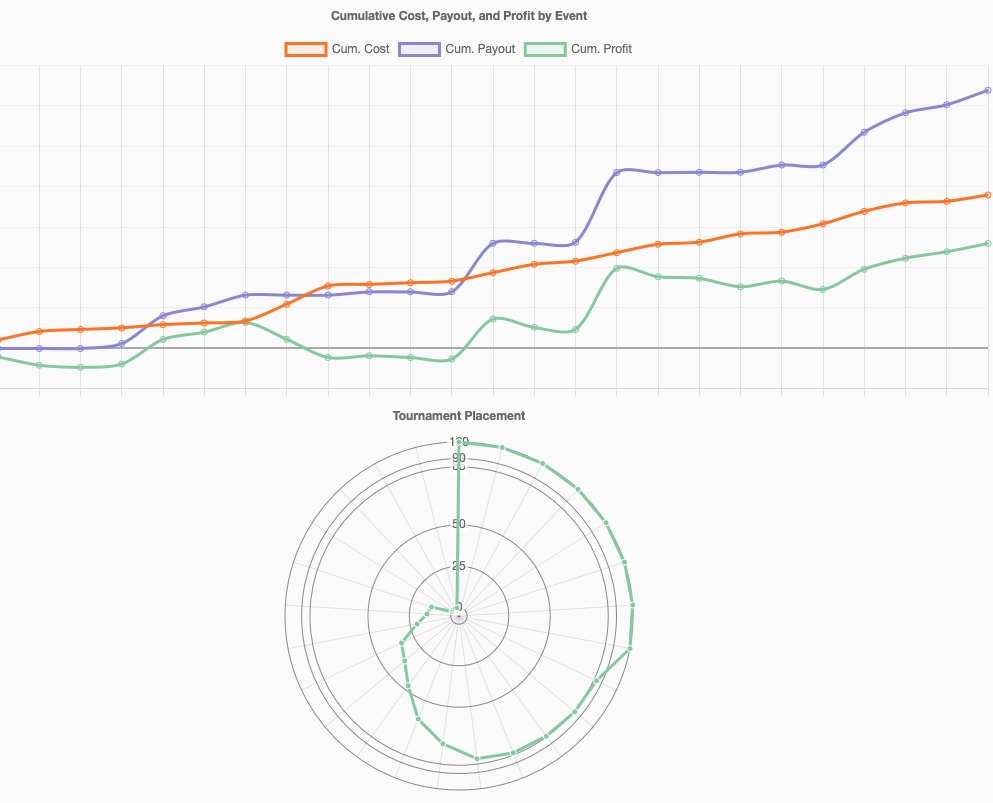
Finally, some charts. As a big believer in data science and poker–let’s call it Moneychip–I’ve made a variety of charts over the years to try to figure out what, if anything,I was good at, and just how good “good” was. Aside from the standard cumulative cost, payout, and profit line chart at the top, the radar chart below it shows me where I’ve finished in tournament fields as a percentage of the field. As I mentioned, it’s been a good couple of months, with the upper-right quadrant ofthe Tournament Placement chart showing 1st-place finishes in more than a quarter of the events over April and May (I was first out in several events, as well). My version of the chart has grid lines at 90% (the old standard for payouts in larger fields) and 85% (the standard at the WSOP in most events). but smaller events often pay higher percentages, if barely.
So. That’s it for this edition. I’ve got more charts to make. Maybe some poker.
May turned out to be the calm before the storm of the WSOP for me. I only played nine tournaments the whole month, with most of those being in the virtual Beaverton Quarantine home game (four cashes, in NLHE and NLHE Bounty) for a meagre 126% ROI. The loss (bigger) came from the three events I entered at the Portland Meadows Poker Classic, though I did manage to pick up one min-bounty in Event #6 PLO Assassins PKO Bounty (the entire prize pool was bounties!)
That leaves either well-rested or unprepared for next weekend’s trip to Las Vegas, where the bracelet events on my list are Event #27 Big O, Event #32 Seven-Card Stud, and Event #35 HORSE (the only bracelet event I’ve ever cashed in). Plus—depending on how things go—some of the Milestone Satellites and the Monday HORSE Deepstack. Maybe something on WSOP.com if I can figure out how screwed up my account is after six years of inactivity.
Chinook Winds Debuts Summer Series
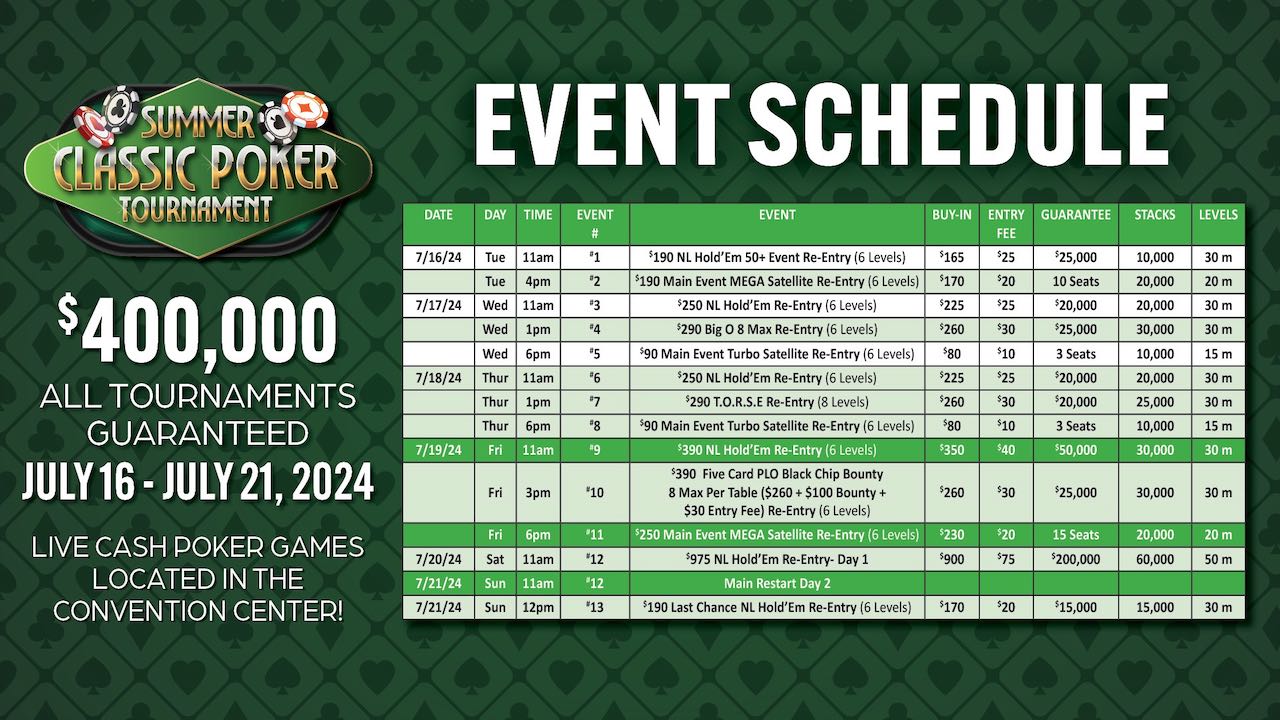
Earlier, as I as getting ready to publish this, Chinook Winds dropped the schedule for their first Summer Classic Poker Tournament, featuring a $200K GTD Main Event and a mid-week TORSE event (with Limit Triple Draw 2-7 replacing Limit Hold’em in the rotation).
Pacific Northwest Poker Leaderboard
Key to the Leaderboard
Name and home town (according to the player’s Hendon Mob profile).
The player’s most recent ranking in the PNW Poker Leaderboard in italics. If this is their first time on the Leaderboard, an em dash (—)
Their new standing in bold, preceded by the pound sign (#).
Their change in status on the Leaderboard (with an arrow indicating up or down), or a black club (♣) if this is their first appearance.
For each of the tournaments that are being recognized in this Leaderboard:
The name and link to the Hendon Mob listing for that tournament.
The player’s finishing position in the tournament and the number of entries.
While everyone was watching Adam Nattress in Event #4 (see below), Mollala’s Smith snuck through nearly 3,600 other players to grab an exceptionally good first Hendon Mob cash.
Word went out on Day 2 that Adam was in the top 10% of the players at the end of Day 1. Then he powered his way to a not-insignificant lead by the end of Day 2. But the headline on the day-end wrap-up mentioned Jamie Kerstetter and “Miami” John Cernuto (and had pictures of both of them) but no Nattress. I knew Adam was too nice a guy to make anything out of it, but Karen-ed the heck out of it.
The Day 3 opening report had a pic of Adam but his name was initially missing from the headline. It was corrected relatively soon. Squeaky wheels, folks! You only get into these positions very rarely; make sure you get the credit you deserve!
Another month of nothing good to report! 14 shots at the Ignition Casino NLHE Jackpot Sit-and-Go, just 3 cashes and none of them any higher payout than 2x buy-in. I got a couple of tickets from America’s Cardroom for satellites and a ticket from Ignition for their $2500 GTD Freeroll and nothing came of those.
Just a min-cash in one of three Beaverton Quarantine home game bounty tournaments (and a bare bounty in another), plus three bricks in non-bounty tournaments. Thankfully, those aren’t expensive.
After a five-month hiatus, I went back to the Final Table $20K GTD NLHE First Friday tournament, where I only made it though half the field, but had a very nice interaction about the blog with Brian Barker, who won a quarter-million in a World Poker Tour tournament last fall (as well as a bunch of other stuff). It was a fun evening, but too short.
Capped off the month trying to catch the lightning in a bottle at the Portland Meadows Big Bet Mix 6-Max. I’d taken second somehow last fall but only made it to 25th this time, doing quite well sitting with the likes of Jeremy Harkin and Joe Brandenburg, then less well sitting with my nemesis Butcher.
They modified the structure to add another level before break, at 61K I’m about 10K behind my pace on the last game, but still about 1.5 average. pic.twitter.com/0fJKtnSI3x
Next week is the Portland Meadows Poker Classic, of which I’m planning to play the Monday, Wednesday, and Thursday events. (Wheel of Chaos, baby!) Not sure what the rest of May holds, but I’m just over a month out from my trip to the World Series of Poker.
Pacific Northwest Poker Leaderboard
Key to the Leaderboard
Name and home town (according to the player’s Hendon Mob profile).
The player’s most recent ranking in the PNW Poker Leaderboard in italics. If this is their first time on the Leaderboard, an em dash (—)
Their new standing in bold, preceded by the pound sign (#).
Their change in status on the Leaderboard (with an arrow indicating up or down), or a black club (♣) if this is their first appearance.
For each of the tournaments that are being recognized in this Leaderboard:
The name and link to the Hendon Mob listing for that tournament.
The player’s finishing position in the tournament and the number of entries.
Another month in the red, though I briefly had hopes for this one.
No need to recap all of the thrill of min-victory and the agony of defeat at the Chinook Winds PacWest Poker Classic in the middle of the month, it’s all right here if you want to read about it.
I cashed 7 out of 17 Ignition Casino NLHE Jackpot Sit-and-Go tournaments, with just one of the winners being a 5x payout, which means…exactly $0 profit.
Because I spent an entire week at Chinook Winds, no other live play for me, though I did play five Beaverton Quarantine games via PokerStars Home Games, min-cashing a 10-player NLHE game and winning a NLHE Bounty tournament with three bounties (including my own) for a whopping 320% ROI. Not enough to cover my losses at the PacWest series!
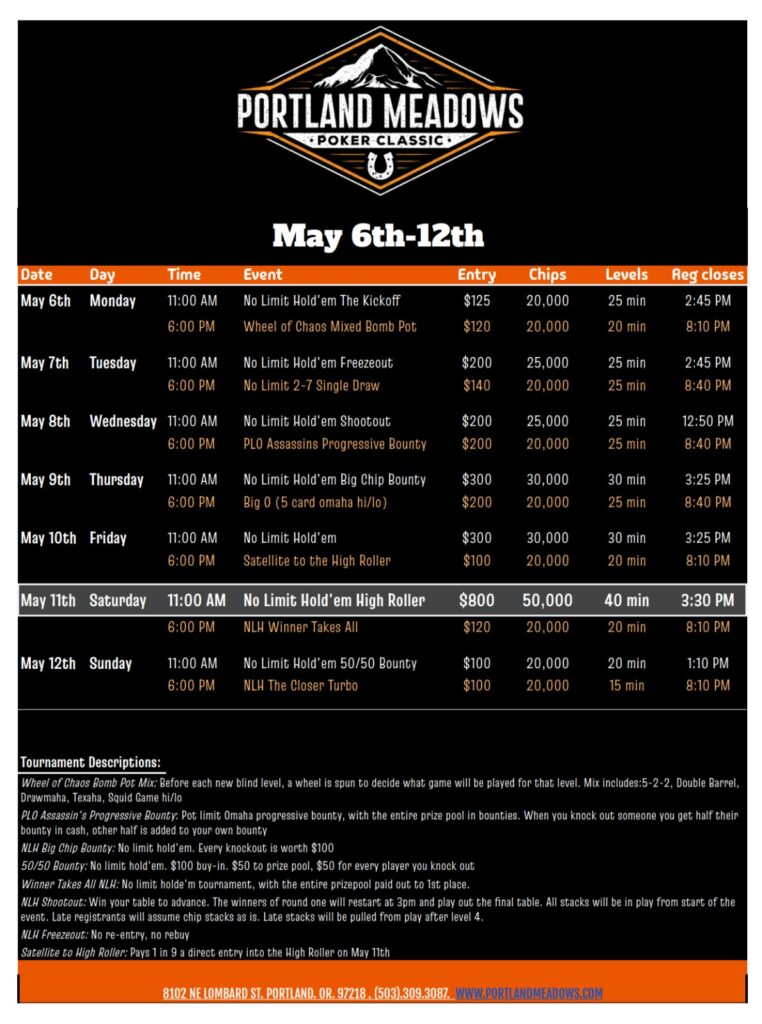
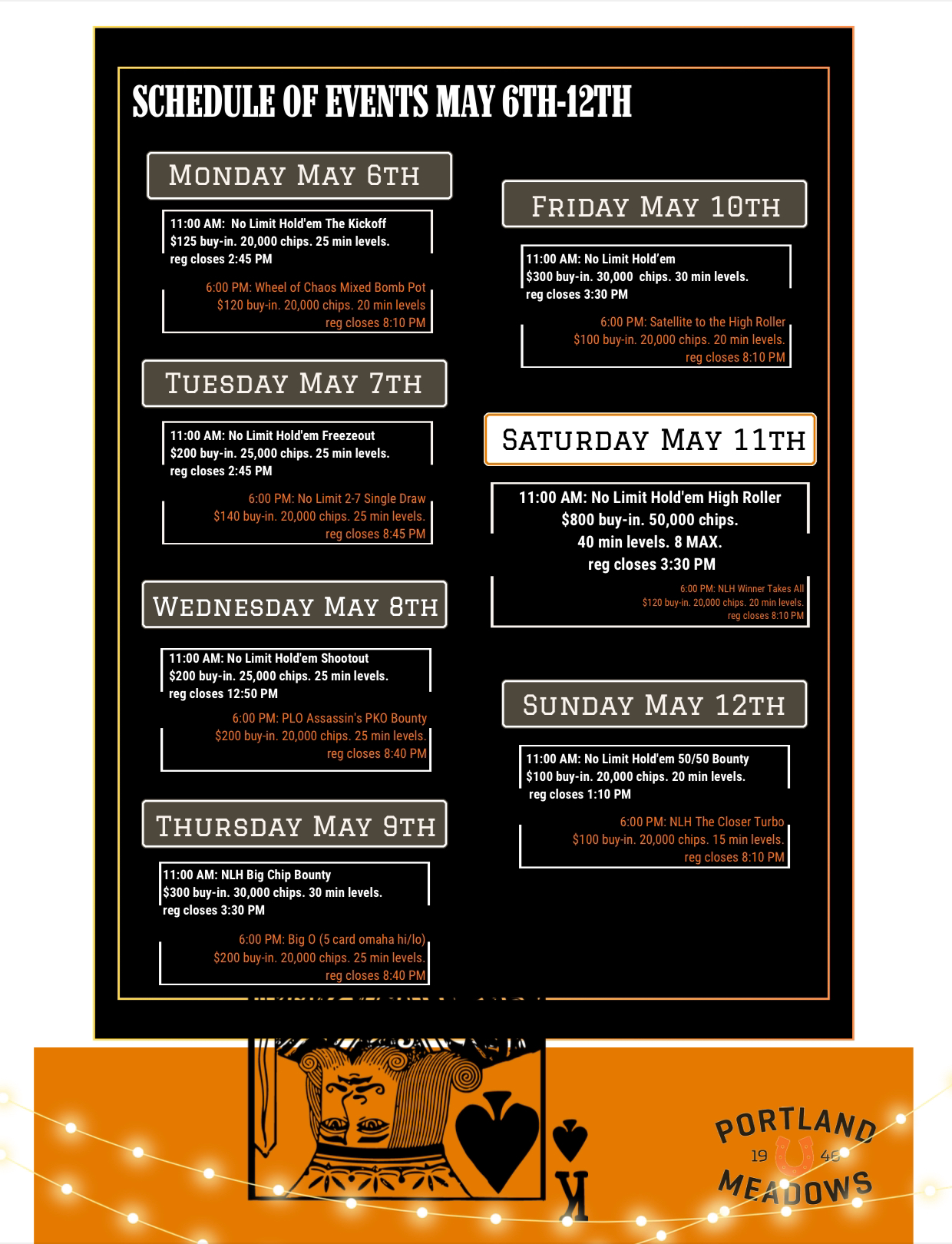
There’s a whole bunch of fun coming up May 6th–12th at the Portland Meadows Poker Classic, though I’m going to have to skip their High Roller because I’ve got tickets to see Michelle Wolf. And I can only do the evening games because, you know…job.
I’ve booked my flight to the WSOP already. Got a lot of $2K and $5K satellites on my menu, along with HORSE, Seven Card Stud, and Big O,
Pacific Northwest Poker Leaderboard
Due to some fast reporting by the Chinook Winds tournament officials, this edition of the Leaderboard includes the big results from the recent PacWest Poker Classic!
Key to the Leaderboard
Name and home town (according to the player’s Hendon Mob profile).
The player’s most recent ranking in the PNW Poker Leaderboard in italics. If this is their first time on the Leaderboard, an em dash (—)
Their new standing in bold, preceded by the pound sign (#).
Their change in status on the Leaderboard (with an arrow indicating up or down), or a black club (♣) if this is their first appearance.
For each of the tournaments that are being recognized in this Leaderboard:
The name and link to the Hendon Mob listing for that tournament.
The player’s finishing position in the tournament and the number of entries.
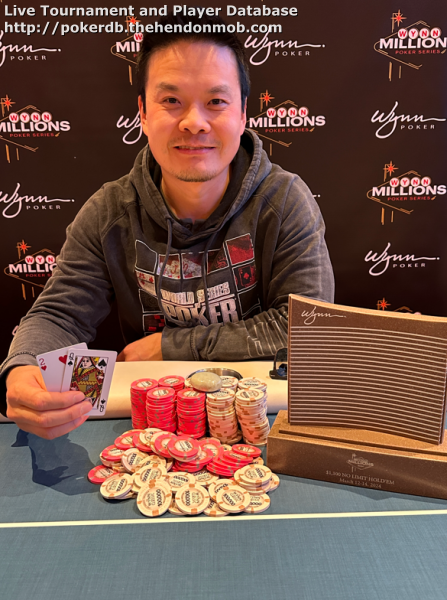
This is Heang’s debut on the Leaderboard, though he has a couple other cashes that would have qualified him last year when I wasn’t keeping the Leaderboard updated.
Davies had six other cashes in the Triton Jeju series (for a total of eight cashes in seventeen events) each large enough to put most players’ career winnings to shame, but their ROI was less than 400%, so they do not appear on the Leaderboard.
The results are in! The asterisk in the title is because previous years are ranked by the finishing place of the folks on the final table, but the results for this year are by starting stack on the final table until the tournament’s done.
Years ago, I had a discussion with someone about how they thought there would never be another Main Event winner over the age of 40. That was just before Qui Nguyen won it at 39 and a couple of years before Hossein Ensan took it down at 55. Adam Walton has a significant chip lead going into the day. He’s 40.
[UPDATE] Walton did make it to Day 2 of the Final Table, but not for long. Congrats to Daniel Weinman!